






.png)


Creating a Culture: The Life You Build Within Yourself and Around You

Culture is often discussed as though it belongs only to organizations. We speak about workplace culture, team culture, family culture, church culture, school culture, and community culture. Those applications matter, but they are incomplete. Culture is not confined to groups or institutions. Every individual establishes a culture for their own life.
The personal culture you create determines what becomes normal in your world. It shapes how you speak to yourself when you fail, what you tolerate in your relationships, how you respond to pressure, what you repeatedly consume, how you spend your time, which standards govern your decisions, and what kind of future you make possible. Before culture becomes visible in a company, household, or community, it often begins as a private pattern inside an individual.
Edgar Schein and Peter Schein (2017) described culture as something that is “constantly enacted and created by our interactions with others and shaped by leadership behavior” (p. 3). That insight applies powerfully to external environments, but it also provides a useful lens for examining the internal environment of a person’s life. You are always interacting with yourself through your thoughts, interpretations, routines, emotions, decisions, and standards. Those repeated interactions teach you what is normal, what is possible, and what is expected.
The Validus Creating a Culture framework explains how that process unfolds:
Influence or power → Atmosphere → Climate → Belief system → Culture
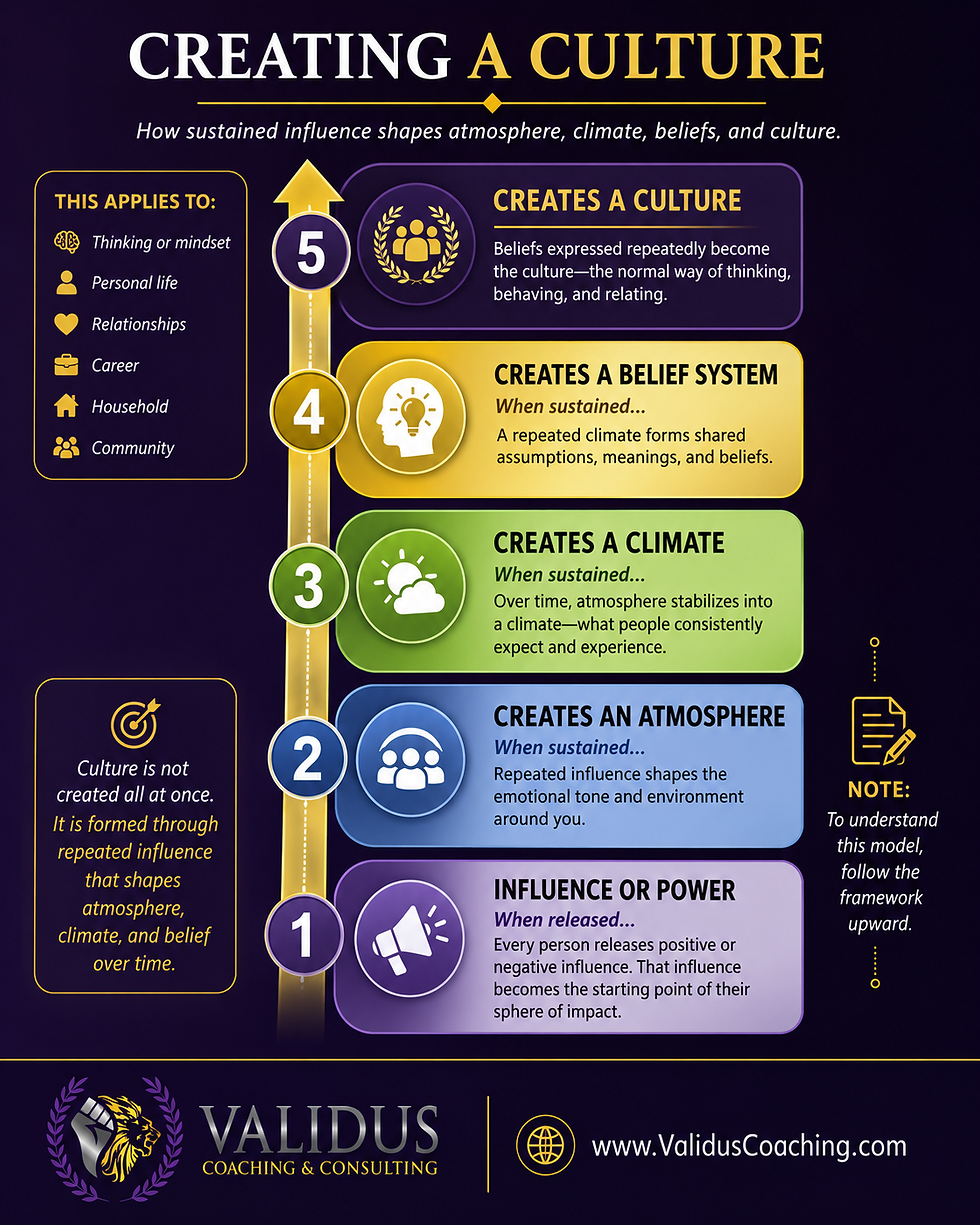
The model applies to the culture you establish within yourself, the culture you create in relationships, the climate you build in a household, the environment you shape at work, and the impact you have in your community. Culture is not formed all at once. It is formed through repeated influence that becomes an atmosphere, stabilizes into a climate, develops into a belief system, and eventually becomes the normal way of thinking, behaving, and relating.
Culture Begins Before Anyone Else Is Involved

Most people underestimate the extent to which they are building a personal culture every day. They may believe they are simply reacting to life, handling responsibilities, managing stress, or trying to get through the week. Yet beneath those daily actions, a deeper pattern is forming. The way a person responds to disappointment becomes part of their personal culture. The way they handle conflict becomes part of their personal culture. The way they speak to themselves after a setback becomes part of their personal culture.
Personal culture is not merely a collection of habits. Habits are part of it, but culture is broader. Your personal culture includes the standards you protect, the boundaries you maintain, the stories you repeat, the relationships you allow access to your life, the emotional patterns you normalize, the environments you choose, and the identity you reinforce through action.
For example, a person may say they want peace, growth, confidence, or discipline. However, the culture of their life may be built around chaos, avoidance, self-criticism, impulsivity, or overcommitment. Their stated desires may point in one direction while their repeated patterns move them in another. This is why intention alone is not enough. The culture of a life is revealed by what is repeatedly practiced, not merely by what is occasionally desired.
James Clear (2018) offered a useful systems-based perspective when he wrote, “You do not rise to the level of your goals. You fall to the level of your systems” (p. 27). Personal culture is the system beneath the goal. It is the operating environment that determines whether goals are supported, delayed, undermined, or abandoned.

A person who wants greater confidence but repeatedly rehearses self-doubt is creating a personal culture that contradicts the goal. A person who wants healthier relationships but consistently avoids difficult conversations is creating a culture of emotional distance. A person who wants professional growth but repeatedly postpones preparation, visibility, and action is creating a culture of hesitation. The outcome is not random. It is the result of the culture being built beneath the surface.
Influence or Power: What Are You Releasing Into Your Life?
The framework begins with influence or power. In this model, power does not mean control over other people. It refers to the capacity to affect an environment. Every person has this capacity. They release influence through language, emotional energy, choices, attention, expectations, example, and response.

John Maxwell’s leadership work consistently emphasizes that influence is the essence of leadership. That principle matters because leadership begins long before someone receives a title. You lead your life through the influence you repeatedly exert over your own decisions, habits, time, relationships, and internal dialogue. You also lead others through the emotional and behavioral patterns you bring into shared spaces.
Your influence may be constructive or destructive, intentional or unconscious, stabilizing or chaotic. It may create courage in others, or it may make people guarded. It may create self-respect within you, or it may reinforce shame and self-doubt. The point is not that every moment must be perfect. The point is that repeated influence becomes formative.
Consider the influence you release into your own life through your internal language. A person who repeatedly tells themselves, “I always mess things up,” “I am behind,” “I am not ready,” or “I never follow through” is not merely expressing frustration. They are creating an internal atmosphere shaped by defeat, hesitation, and self-protection. Over time, those repeated messages become evidence for a limiting identity.
By contrast, constructive internal influence does not require denial or false positivity. It means speaking truthfully and responsibly. It sounds more like, “This did not go the way I wanted, but I can learn from it,” “I need to make a correction,” “I am capable of handling the next step,” or “I do not have to remain who I was in the last season.” That kind of language does not remove difficulty, but it changes the environment in which difficulty is interpreted.
The same principle applies externally. A leader who consistently brings clarity, steadiness, accountability, and respect creates a different atmosphere than a leader who brings unpredictability, defensiveness, blame, and emotional volatility. A parent who consistently listens, corrects with dignity, and follows through creates a different environment than one who communicates through fear or inconsistency. A partner who approaches difficult conversations with honesty and restraint creates a different relationship culture than one who withdraws, attacks, or avoids.
Influence is the starting point because culture begins with what is repeatedly released.
When Influence Is Sustained, It Creates an Atmosphere
Atmosphere is the immediate emotional tone of an environment. It is what people feel before they can always explain it. A home can feel peaceful or tense. A workplace can feel focused or chaotic. A relationship can feel safe or emotionally expensive. A person’s internal world can feel grounded or hostile.
Atmosphere is not imaginary, and it is not insignificant. It influences how people think, communicate, make decisions, and interpret events. In personal life, atmosphere shapes the emotional weather you live in every day. When your personal atmosphere is dominated by urgency, comparison, resentment, or self-criticism, even ordinary challenges can feel heavier than they are. When your personal atmosphere includes discipline, honesty, self-respect, perspective, and emotional regulation, challenges may still be difficult, but they do not have to become identity-defining.
This is why a person must become aware of the environment they are creating within themselves. Many people attempt to change their results without examining the atmosphere in which they are trying to grow. They set a goal to become more confident while continuing to surround themselves with voices, media, relationships, and routines that reinforce inadequacy. They want peace while maintaining a personal environment built on constant stimulation, unresolved conflict, and overextension. They want focus while allowing distraction to dominate their attention.
The atmosphere of your life is shaped by what you repeatedly allow, reinforce, and practice. It is shaped by the conversations you entertain, the standards you compromise, the environments you enter, and the emotional patterns you tolerate. It is also shaped by the way you respond when life does not cooperate with your plans.
In group settings, atmosphere has similar consequences. Amy Edmondson (1999) defined team psychological safety as “a shared belief held by members of a team that the team is safe for interpersonal risk taking” (p. 350). Her research demonstrated that when people believe they can ask questions, acknowledge mistakes, raise concerns, and offer ideas without humiliation, they are more likely to learn and contribute.
That principle applies beyond formal teams. In a relationship, emotional safety determines whether people can speak honestly. In a household, it determines whether concerns are addressed or buried. In a community, it influences whether people feel valued, dismissed, welcomed, or excluded. In a personal life, it shapes whether you can face your own mistakes with honesty or whether you hide from them through avoidance, excuses, and self-attack.
When Atmosphere Is Sustained, It Creates a Climate
Atmosphere is the emotional tone of the present moment. Climate is the pattern people come to expect over time. A difficult day does not necessarily create a negative climate. One stressful meeting does not permanently damage a team. One disagreement does not define a relationship. Climate forms when a particular emotional pattern becomes predictable.
Culture is not what you say matters. Culture is what your repeated influence teaches you, and everyone around you, to believe. — Vince Morales
A person may have an occasional anxious day without creating an anxious personal climate. However, when anxiety becomes the default lens through which everything is interpreted, the climate of that person’s life begins to change. They may start expecting problems, assuming the worst, delaying action, and treating uncertainty as danger. Their decisions then become shaped by the climate they have normalized.
The same pattern appears in relationships and organizations. A family may experience one conflict without becoming a conflict-driven household. Yet when criticism, sarcasm, emotional withdrawal, inconsistency, or unspoken resentment become repeated, people begin to expect them. They adapt. They protect themselves. They stop bringing concerns forward, stop asking for what they need, and stop believing that difficult conversations can lead to healthy resolution.
Climate answers an important question: What do people expect here?
In a healthy personal climate, you may expect yourself to take responsibility, tell the truth, recover from setbacks, honor commitments, and make corrections without collapsing into shame. In an unhealthy personal climate, you may expect yourself to procrastinate, abandon goals, criticize yourself, overreact emotionally, or retreat when things become difficult.
Those expectations matter because they shape behavior before the moment of decision arrives. A person who expects themselves to fail may not fully engage. A person who expects conflict to become destructive may avoid important conversations. A person who expects honesty to be punished may remain silent. A person who expects growth through challenge is more likely to remain present when discomfort arrives.
Brené Brown’s (2018) work on leadership and vulnerability reinforces the importance of clarity in shaping relational environments. When expectations are vague, people often fill the gaps with assumption, fear, or self-protection. When expectations are clear, people have a stronger foundation for trust, ownership, and meaningful accountability.
A healthy climate does not mean there is no pressure, disagreement, or difficulty. It means people know how pressure will be handled. They know what happens when mistakes occur. They know whether honesty will be welcomed or punished. They know whether commitments mean something. They know whether respect remains present when emotions rise.
When Climate Is Sustained, It Creates a Belief System
Over time, people create beliefs about the environments they repeatedly experience. Those beliefs may be spoken openly, but many of them remain silent. They become internal rules about what is safe, what is possible, what is valued, and what is expected.
In a personal culture, those beliefs may sound like this: “I can trust myself to follow through.” “I have to be perfect before I begin.” “My voice matters.” “I should stay quiet to avoid conflict.” “I can recover when I make a mistake.” “I have to earn rest.” “Discomfort means I am growing.” “Discomfort means I should quit.”
The belief system formed beneath a person’s life determines how they interpret reality. Two people may encounter the same setback and create entirely different meanings from it. One may conclude, “This proves I am not capable.” Another may conclude, “This shows me what I need to strengthen.” The event is the same. The meaning system is different.
That distinction matters because people often try to change behavior without examining the belief system beneath it. They may tell themselves to be more disciplined, confident, assertive, or resilient. Yet if the underlying belief remains, “I am not the kind of person who follows through,” “I do not deserve success,” or “People will reject the real me,” then behavior change will remain fragile.
Schein and Schein (2017) explained that the deepest layer of culture involves underlying assumptions that become taken for granted. In organizations, these assumptions influence how people interpret events and determine appropriate behavior. In personal life, the same logic can be applied as a coaching lens. The beliefs you repeatedly reinforce become the invisible rules that shape your choices.
This is why transformation requires more than improved behavior. It requires inspection. You have to ask what belief is operating beneath the behavior. You have to identify the internal agreement that makes the old pattern feel normal. You have to determine whether the belief reflects reality or whether it reflects an outdated identity, unresolved wound, fear-based conclusion, or inherited narrative.
A person who repeatedly says, “I just need to get more motivated,” may not have a motivation problem. They may have a belief problem. They may be trying to build a new future while still operating from an old self-image. The behavior is only the visible surface. The belief system is the deeper structure.
When Beliefs Are Sustained, They Create a Culture
Culture is the normal way of thinking, behaving, deciding, communicating, and relating. It is what becomes familiar enough that people stop questioning it. It is not what a person, family, or organization claims to value. It is what their repeated patterns teach everyone to expect.

A personal culture of self-respect looks different from a personal culture of self-abandonment. In a culture of self-respect, a person keeps commitments to themselves, protects their energy, tells the truth about their circumstances, seeks support when needed, and refuses to let one setback become an excuse to stop growing. In a culture of self-abandonment, a person repeatedly ignores their needs, breaks promises to themselves, permits harmful patterns, and then wonders why confidence remains low.
A relationship culture of trust looks different from a relationship culture of fear. In a culture of trust, people can raise concerns, repair harm, communicate needs, and work through disagreement without attacking each other’s identity. In a culture of fear, people manage appearances, avoid honesty, withhold needs, and become increasingly disconnected.
A workplace culture of accountability looks different from a workplace culture of blame. In an accountable culture, people own mistakes, communicate early, seek solutions, and learn from failure. In a blame culture, people protect themselves, hide problems, point fingers, and focus more on avoiding consequences than improving outcomes.
Culture is revealed through the ordinary moments that people often overlook. It is revealed in how people respond when someone is late, overwhelmed, wrong, vulnerable, successful, disappointed, or difficult. It is revealed in the way leaders speak about people who are not in the room. It is revealed in whether promises are kept, whether feedback is welcomed, whether standards are applied fairly, and whether people are treated with dignity under pressure.
The culture of your life is your legacy in motion. It is the environment you create before you ever create an outcome.
The Personal Culture You Create for Your Life
The most important application of this framework may be the culture you create for yourself. Before you can consistently build a healthier home, relationship, team, or organization, you must examine the culture governing your own life.
What is normal for you when you are disappointed? What is normal for you when you feel uncertain? What is normal for you when you receive feedback? What is normal for you when you have an opportunity to move beyond your comfort zone?
The answers reveal your personal culture.
You do not rise to the level of your goals. You fall to the level of your systems — James Clear
Some people have unintentionally created a culture of delay. They wait until they feel ready, certain, confident, inspired, or fully prepared before they act. Yet readiness becomes a moving target, and years can pass while potential remains unexpressed. Others have created a culture of overextension. They say yes to too much, live in a constant state of urgency, neglect recovery, and then confuse exhaustion with significance.
Some people have built a culture of self-doubt. They discount their strengths, magnify their limitations, and interpret every challenge as evidence that they do not belong in the room. Others have built a culture of resilience. They do not deny disappointment, but they have trained themselves to recover, reflect, learn, and continue.
The goal is not to build a personal culture that is rigid, perfect, or emotionally numb. The goal is to build a culture that supports the life you are called to lead. That means creating an internal environment where truth, responsibility, growth, courage, discipline, compassion, and aligned action can become normal.
Research on habits reinforces the importance of repetition in this process. Wood and Rünger (2016) explained that habits form when people repeat responses in recurring contexts. Over time, these patterns become efficient default responses. This means that your repeated responses are training your future self. You are teaching yourself how to react, how to cope, how to decide, and how to interpret life.
The question is whether you are training patterns that serve your future or patterns that preserve an outdated version of you.
Creating Culture in Every Area of Life
The Creating a Culture framework applies in professional life, but it should not remain there. It applies to the personal life culture you establish for yourself, the emotional climate you create in your home, the standards you reinforce in your relationships, and the influence you bring into your community.
In your personal life, the framework asks whether your routines, thoughts, environment, and standards are building the kind of inner world that supports your purpose. It challenges you to examine whether your daily life reflects peace, discipline, self-respect, faith, growth, and intentionality—or whether it reinforces distraction, avoidance, exhaustion, and self-sabotage.
In relationships, the framework asks what your repeated influence is teaching the other person. Are you creating an atmosphere where honesty can survive? Are you reinforcing a climate of safety, respect, and repair? Are your repeated actions creating beliefs that the relationship is dependable, mutual, and emotionally secure?

In a household, the framework asks what becomes normal under pressure. Do family members experience calm correction, clear expectations, and emotional presence? Or do they experience volatility, silence, inconsistency, and fear? Household culture is built in the ordinary interactions that become repeated often enough to feel permanent.
In leadership and career, the framework asks what people experience because you are present. Do you create clarity, ownership, courage, and connection? Or do you create confusion, dependency, guardedness, and emotional fatigue? A leader’s influence does not end with what they say in meetings. It appears in the standards they model, the behavior they reward, and the conduct they refuse to normalize.
In community, the framework asks whether your influence expands dignity, belonging, responsibility, and shared growth. Communities are shaped by people who choose to contribute rather than merely criticize. They are strengthened when individuals become intentional about the atmosphere they bring into shared spaces.
Changing Culture Requires More Than Better Intentions
Culture rarely changes because someone makes a powerful announcement. It changes because repeated evidence begins to challenge the old normal. A person cannot create a personal culture of discipline by declaring that discipline matters once. They create it by repeatedly doing what they said they would do, especially when no one is watching and motivation is low.
A relationship does not become healthier because both people agree that communication matters. It becomes healthier when they consistently practice honesty, emotional regulation, repair, listening, and accountability. A workplace does not become more trusting because leadership introduces a new value statement. It becomes more trusting when people experience consistent follow-through, fairness, transparency, and respectful truth-telling.
This is why culture change must begin with behavior that can be seen, repeated, and reinforced. Values must become visible. Standards must become practical. Expectations must become clear. Consequences must become consistent. The desired culture must become more than language; it must become lived evidence.
The first step is to identify the culture you currently have. This requires honesty. You cannot transform a culture you refuse to name accurately. You must examine the influence being released, the atmosphere it has created, the climate people expect, the beliefs being reinforced, and the culture that has become normal.
The second step is to define the culture you want to create. This must be specific. Words such as respect, accountability, trust, confidence, excellence, and growth are too vague unless they are translated into behavior. Respect may mean addressing concerns directly rather than criticizing behind someone’s back. Accountability may mean communicating early when a commitment is at risk. Confidence may mean taking action before you feel fully ready. Growth may mean receiving feedback without collapsing into defensiveness.
The third step is to practice the culture before you demand it from others. You cannot build a culture of honesty while avoiding your own truth. You cannot build a culture of discipline while repeatedly breaking commitments to yourself. You cannot build a culture of emotional safety while making people pay relationally for being honest. Culture follows modeled behavior more than stated intention.
The fourth step is to confront what contradicts the culture. Every tolerated pattern teaches something. When disrespect is ignored, it becomes normalized. When avoidance is excused, it becomes part of the climate. When leaders protect talented people who damage others, they teach everyone that results matter more than character. A culture cannot become healthy while unhealthy patterns remain protected.
The final step is to reinforce the culture through repetition. What is recognized, practiced, protected, and repeated becomes stronger. What is ignored often expands. What is corrected with consistency becomes less normal. Culture changes when new patterns receive enough repetition to become believable.
A Final Question
You are creating a culture right now. You are creating one in your thoughts, your habits, your relationships, your home, your work, and your influence. The issue is not whether culture is being created. The issue is whether you are creating it intentionally.
Your repeated influence becomes an atmosphere. Your sustained atmosphere becomes a climate. Your sustained climate forms beliefs. Your repeated beliefs become culture. And culture eventually shapes what you believe is possible for your life.
The personal culture you create for yourself will either reinforce the identity you have outgrown or support the person your future requires. It will either normalize limitation or strengthen capacity. It will either keep you operating from old patterns or create the conditions for meaningful transformation.
Culture is not what you say matters. Culture is what your repeated influence teaches you—and everyone around you—to believe.
References
Brown, B. (2018). Dare to lead: Brave work. Tough conversations. Whole hearts. Random House.
Clear, J. (2018). Atomic habits: An easy & proven way to build good habits & break bad ones. Avery.
Edmondson, A. C. (1999). Psychological safety and learning behavior in work teams. Administrative Science Quarterly, 44(2), 350–383.
Maxwell, J. C. (1993). Developing the leader within you. Thomas Nelson.
Schein, E. H., & Schein, P. A. (2017). Organizational culture and leadership (5th ed.). Wiley. Wood, W., & Rünger, D. (2016). Psychology of habit. Annual Review of Psychology, 67, 289–314.


Comments